
Automotive Speaker Component Manufacturing
Table of Contents
Automotive speaker systems are one of the most demanding mass-production programs in injection molding. A single car can carry six to twelve speakers, each built from a cone former, a frame or basket, a grille, terminal housings and mounting brackets — and each part must hold its geometry across temperature swings from -40°C to +85°C while never buzzing or rattling at any frequency. The tolerance chain starts in the tool: if the frame is out by a few hundredths of a millimeter, the magnet gap shifts, voice-coil clearance disappears and the speaker fails its acoustic test.
MOLDITQUICK manufactures the full audio stack — housings, grilles, terminal carriers and brackets — for automotive and consumer audio brands. The program runs on our presses (30T to 260T), with mold and molding tuned together by one accountable engineering team so the cavity design and the part design stay aligned. For a typical speaker frame in PP+20% glass fiber, we hold critical concentricity features to ±0.05 mm and run SPC on every shift.
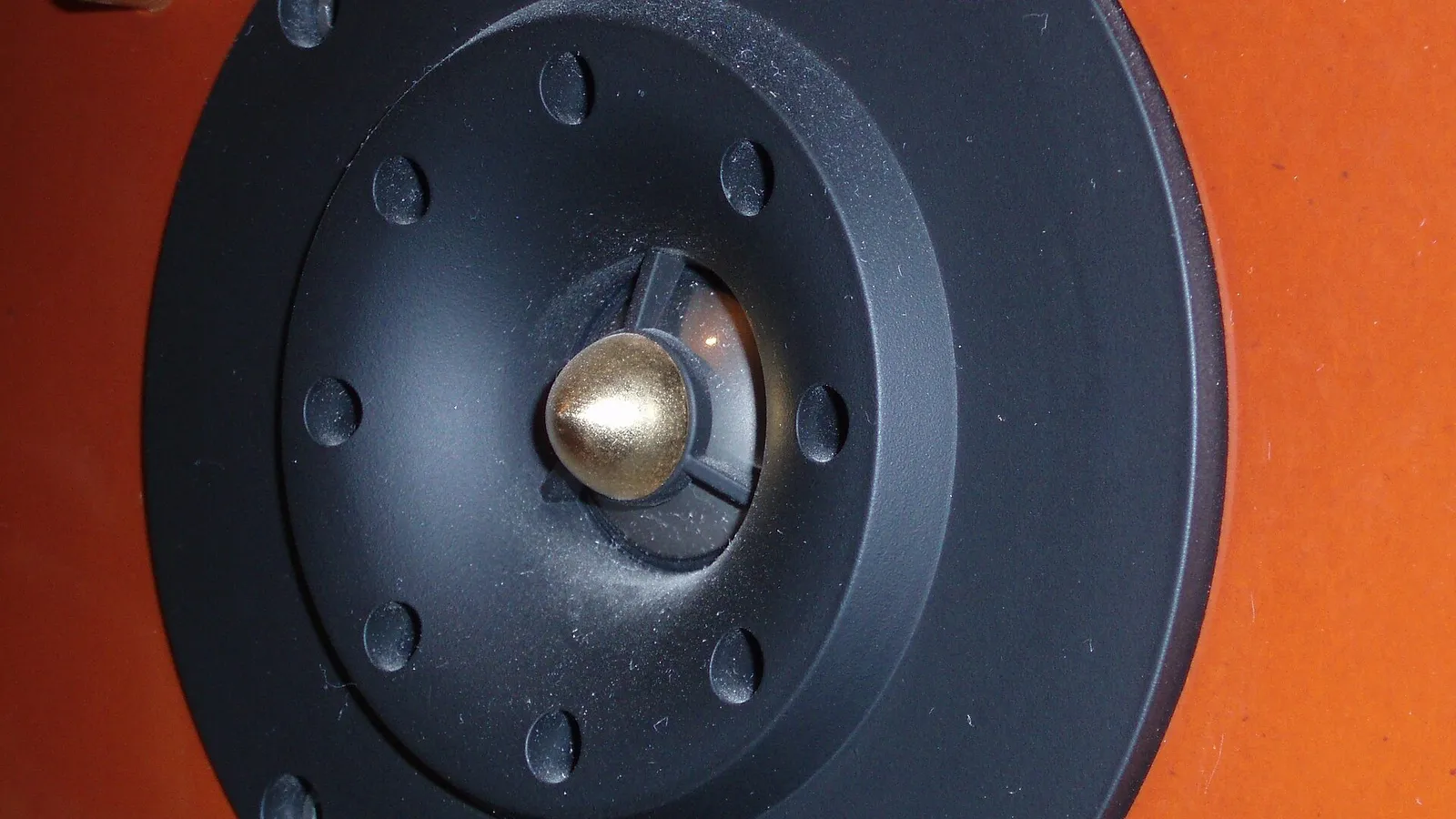
What Makes a Speaker Component Hard to Mold
The grille is the classic example. Thousands of holes, each 0.8-1.5 mm in diameter, molded into a thin panel — the flow length per cavity is short but the gate vestige must be invisible on the front face and the holes must stay perfectly round. We gate on the back side, polish the cavity to SPI A-2, and use a two-stage injection profile so the melt front advances evenly across the hole field. On our automated presses the shot weight is small but repeatable; the closed-loop control holds packing pressure within ±1%.
Brackets and terminal housings add a second problem: dimensional stability. Glass-filled PP shrinks anisotropically, so a bracket that measures correctly at the press will warp after it cools in the warehouse. Our DFM team compensates for shrinkage in the steel and adds ribs on the non-visible face to lock the flatness. For terminal housings we hold insert-to-insert spacing to ±0.02 mm so the crimping and soldering stations downstream never see drift. We apply the same discipline we apply to every audio part.
The full program — grille, frame, terminal housing and bracket — is documented as a speaker component manufacturing case study, with the inspection and acoustic gates listed.
Acoustic Testing and Quality Gates
Cosmetic and dimensional checks are only half the battle. Every speaker component that leaves our 10,000 m² facility in Dongguan passes a gate sequence: first article inspection with a CMM, then dimensional sampling per AQL, then an acoustic test on the assembled unit performed by our customer or their designated lab. Because we mold the housing and the grille in the same factory, the acoustic team gets matched batches — no mixing of material lots across suppliers, which is the most common cause of frequency-response drift in mass production.
For high-volume runs (50,000 to 1 million pieces) we run multi-cavity tools on our automated presses and automate part take-out with sprue pickers. Low-volume validation runs of 500-5,000 pieces move on rapid-tooled schedules; production runs follow the timeline agreed at PO, and we handle export documentation for global delivery. All programs run under IATF 16949 quality management, with PPAP documentation available on request.
If your speaker program is fighting sink marks, warped grilles or inconsistent terminal spacing, send us the 3D model. We will run a DFM review and quote the tool and the part in one pass. Contact us with your drawings or visit our case study library to see comparable programs.
Need a quote? Contact us — upload your 3D file and get a DFM review and an engineered quotation.
NEXT STEP
Ready to Start Your Project?
Send us your requirements — our team responds within 24 hours. Pricing and a realistic lead time come with the reply.
Written by
Ray ChanExport Brand Manager · Injection Molding, Mold Making & DFM. Ray helps global importers and integrators source factory-direct plastic parts and tooling.