
Thread Inserts: How to Add Metal Threads to Plastic
Table of Contents
Thread inserts are how you put a reliable metal thread in a plastic part. Plastic threads (molded or tapped) strip easily — a brass or steel insert distributes the load, survives repeated assembly, and turns a disposable feature into a durable one. The design question is which insert method: molded-in (insert molding places the insert in the cavity before the shot), heat-staked (a press pushes a threaded insert into a molded boss with heat), ultrasonic (vibration melts the plastic around the insert), or press-in (a barbed insert is forced in). Each has a cost, a strength and a process profile.
The strength comparison matters: a molded-in insert — the insert is locked in the plastic as it shrinks — achieves the highest pull-out and torque resistance, because the plastic fully surrounds the insert with no installation damage. Heat-staked and ultrasonic inserts are close behind when the boss is designed for them (the melted plastic re-flows into the insert's knurls and undercuts). Press-in inserts are the weakest and the cheapest — they work for low-load applications but can crack the boss and have the lowest torque retention. The honest rule: for structural or repeated-assembly joints, molded-in or ultrasonic; for light-duty fastening, press-in.
Molded-In vs Post-Molded: The Process Trade
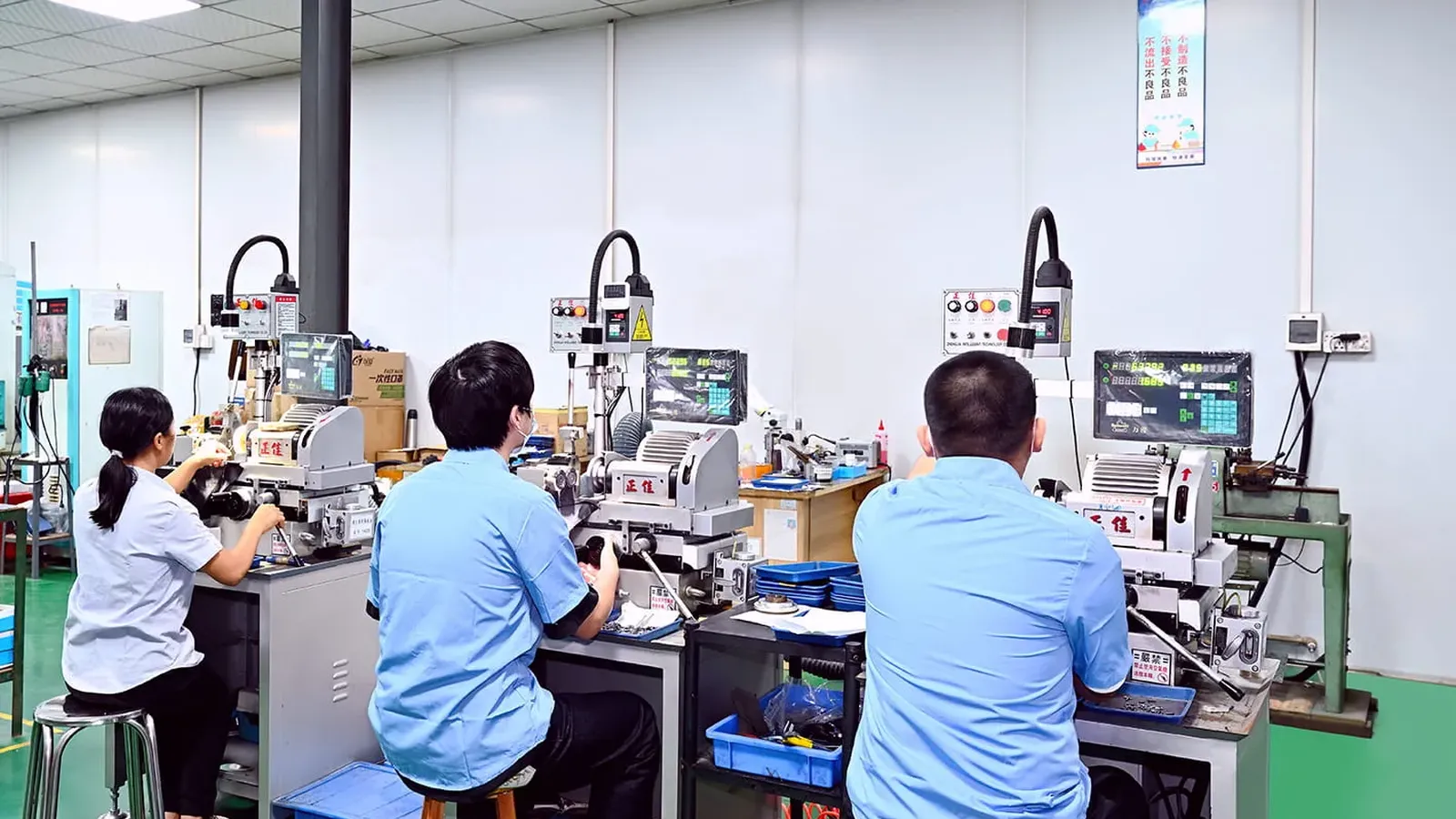
Molded-in inserts (insert molding) add a step to the molding cycle: the insert is loaded into the cavity — automatically, with a robot or bowl feeder — before the shot, and the plastic forms around it. The result is the strongest joint and the best sealing (no path for moisture), at the cost of cycle time and tooling complexity. We run insert molding in our automated vertical cells, which are laid out for automated insert loading; the insert molding service page covers the process in detail. The design rules: the insert should have knurling or undercuts for the plastic to grip, the plastic wall around it should be 1.5-2× the insert diameter where possible, and the insert position must be held to ±0.02 mm during the shot.
Heat-staked and ultrasonic inserts go into a molded boss after the part is made — no cycle-time penalty, standard molding tools, and the inserts are purchased parts rather than custom-loaded components. Heat staking is the simple, low-cost version (a heated tip melts the boss plastic into the insert's internal knurls); ultrasonic insertion is faster and works better on harder plastics (PC, nylon) that resist heat staking. The boss design is the same in both: a cored hole sized to the insert's outer diameter with a slight interference, and wall thickness to avoid cracking. Press-in (barbed) inserts are the budget option — a simple arbor press or a hammer — with the lowest retention.
Choosing the Insert and the Boss Design
The spec process: pick the insert type by load and assembly count (thread size, pull-out force, number of assembly cycles), choose the material (brass is standard — good grip and corrosion; stainless for corrosive environments; phosphor-bronze for marine), and design the boss per the insert maker's published drill and boss dimensions. The torque and pull-out data published by insert manufacturers (PEM, Symmetric, Hafner) are the design reference — and the boss wall thickness drives the molding design. Our DFM checklist reviews insert bosses for wall, draft and gate placement as standard.
For comparison, thread-insert programs run across full-service molding operations with insert molding and post-molding insertion both offered. At MOLDITQUICK we can do all four methods — molded-in on the vertical presses, heat-stake and ultrasonic on the finishing line, press-in for low-volume — so the choice is engineering, not supplier capability.
If your plastic threads are stripping or you are designing a new joint — send us the part, the thread size and the load requirement. We will recommend the insert method and quote the complete program. Contact us to start.
Need a quote? Contact us — upload your 3D file for a fast DFM review.
NEXT STEP
Ready to Start Your Project?
Send us your requirements — our team responds within 24 hours. Pricing and a realistic lead time come with the reply.
Written by
Ray ChanExport Brand Manager · Injection Molding, Mold Making & DFM. Ray helps global importers and integrators source factory-direct plastic parts and tooling.